Wine Glass Resonance
A singing wine glass reveals standing wave modes as water dances at its resonant frequency.
What You Learn
Run a wet finger around the rim of a wine glass and it sings — a pure, haunting tone that has captivated natural philosophers for centuries. The physics behind this simplicity is surprisingly rich. Your finger engages in stick-slip excitation, catching and releasing the glass rim in rapid succession, pumping energy into the glass at its natural resonant frequency. The glass responds with flexural vibration: the rim distorts into an elliptical shape, oscillating between two perpendicular ellipses many hundreds of times per second. These are circumferential standing waves — the walls of the glass become a circular waveguide, bending in and out in patterns described by mode numbers (n, m) just as a drumhead vibrates in two-dimensional modes.
What makes this experiment visually stunning is the water inside. As the glass rings, the vibrating walls couple energy into the liquid surface, driving a parametric instability first described by Faraday. Tiny standing waves erupt on the water, forming concentric ripples, radial spray lines, and — at sufficient amplitude — fine droplets that leap from the crests. The water becomes a projection screen for the glass's invisible modal geometry, translating a vibration you can hear into one you can see.
Benjamin Franklin was so enchanted by the singing glass that in 1761 he invented the glass armonica, an instrument of nested glass bowls rotated on a spindle and played with moistened fingers. Mozart, Beethoven, and dozens of other composers wrote for it. The armonica was, in essence, a keyboard of resonant modes — each bowl tuned to a different pitch by its diameter, thickness, and glass composition. This experiment recapitulates the same physics that captivated an era.
By the end, you will understand flexural mode shapes, why thinner glass rings more easily, how water level tunes the pitch, and why — at extreme amplitude — a glass can shatter when driven at its resonant frequency.
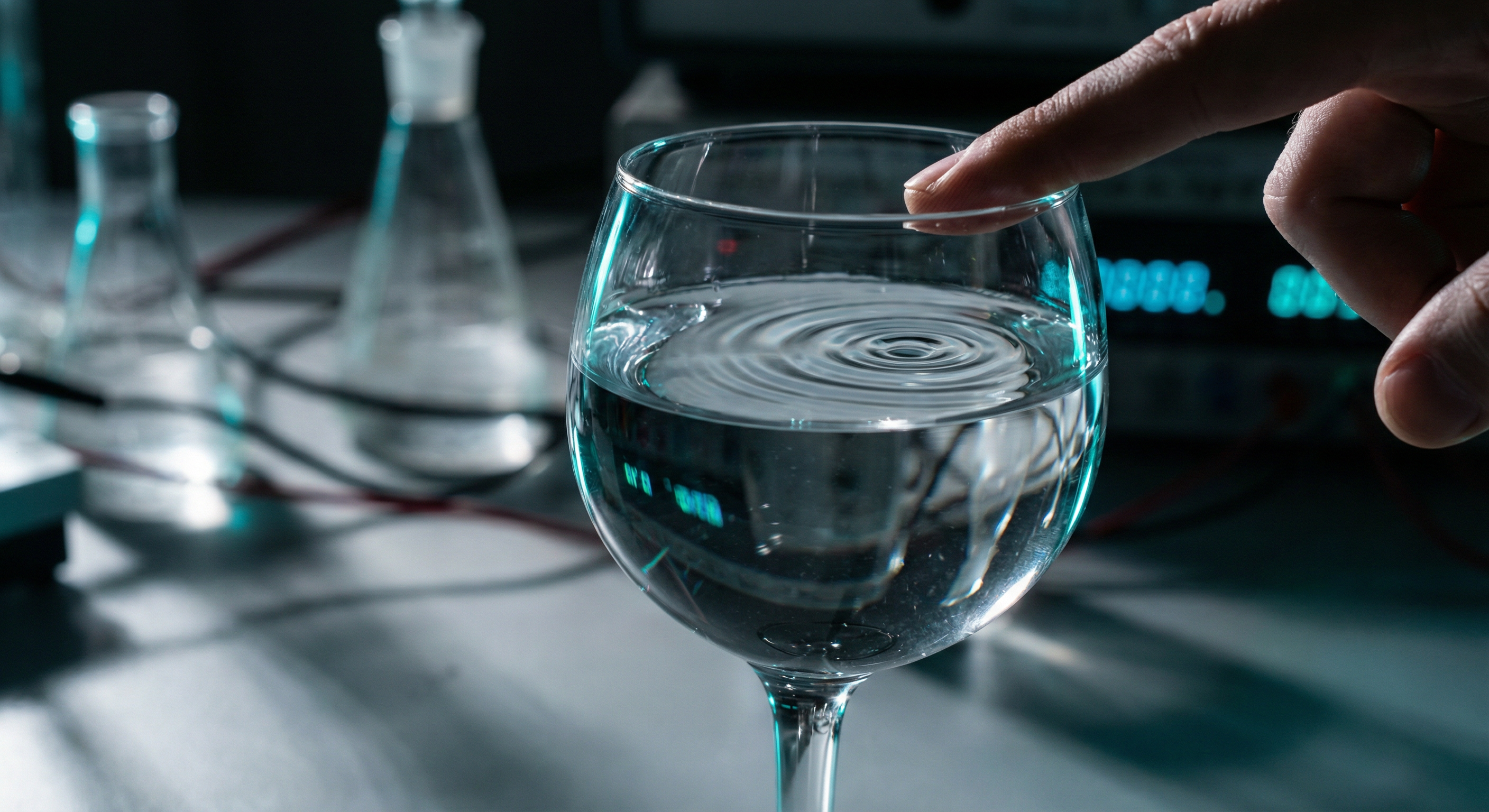 Standing waves on the water surface — the glass's flexural mode made visible.
Safety
- Thin crystal glasses can shatter when driven at high amplitude, especially by an external speaker or sustained bowing — wear safety glasses during loud excitation
- Broken glass hazard: Keep a dustpan nearby; stop immediately if you hear crackling or see stress fractures
- Wet rims and water spills make surfaces slippery — keep your workspace tidy
- Ear protection recommended if amplifying the tone electronically above 85 dB
Safety rating: Green — Minimal risk with standard glassware at finger-driven amplitudes.
Materials
Wine Glass
$3–15Thin-walled crystal or glass wine glass with a clear ring when tapped.
Tip: Crystal glasses resonate more readily than ordinary glass.
Links coming soonWater
FreeTap water for filling the glass to various levels.
Tip: Room-temperature water gives the most stable tone.
Links coming soonWet Cloth or Sponge
$1–2Keep fingers clean and moist for consistent stick-slip excitation.
Tip: A damp sponge beside you saves constant trips to the sink.
Links coming soonTuning App
FreeSmartphone app displaying real-time frequency, for identifying the resonant pitch.
Tip: Apps with spectrogram view let you see harmonics above the fundamental.
Links coming soonFood Coloring
$2–3Optional — tint the water to make surface wave patterns more visible.
Tip: A few drops of contrasting color against the glass improves photography.
Links coming soonStrobe Light
$10–20Optional — freeze the standing wave pattern on the water surface for observation.
Tip: Set the strobe slightly off-frequency to see the pattern rotate in slow motion.
Links coming soonSetup
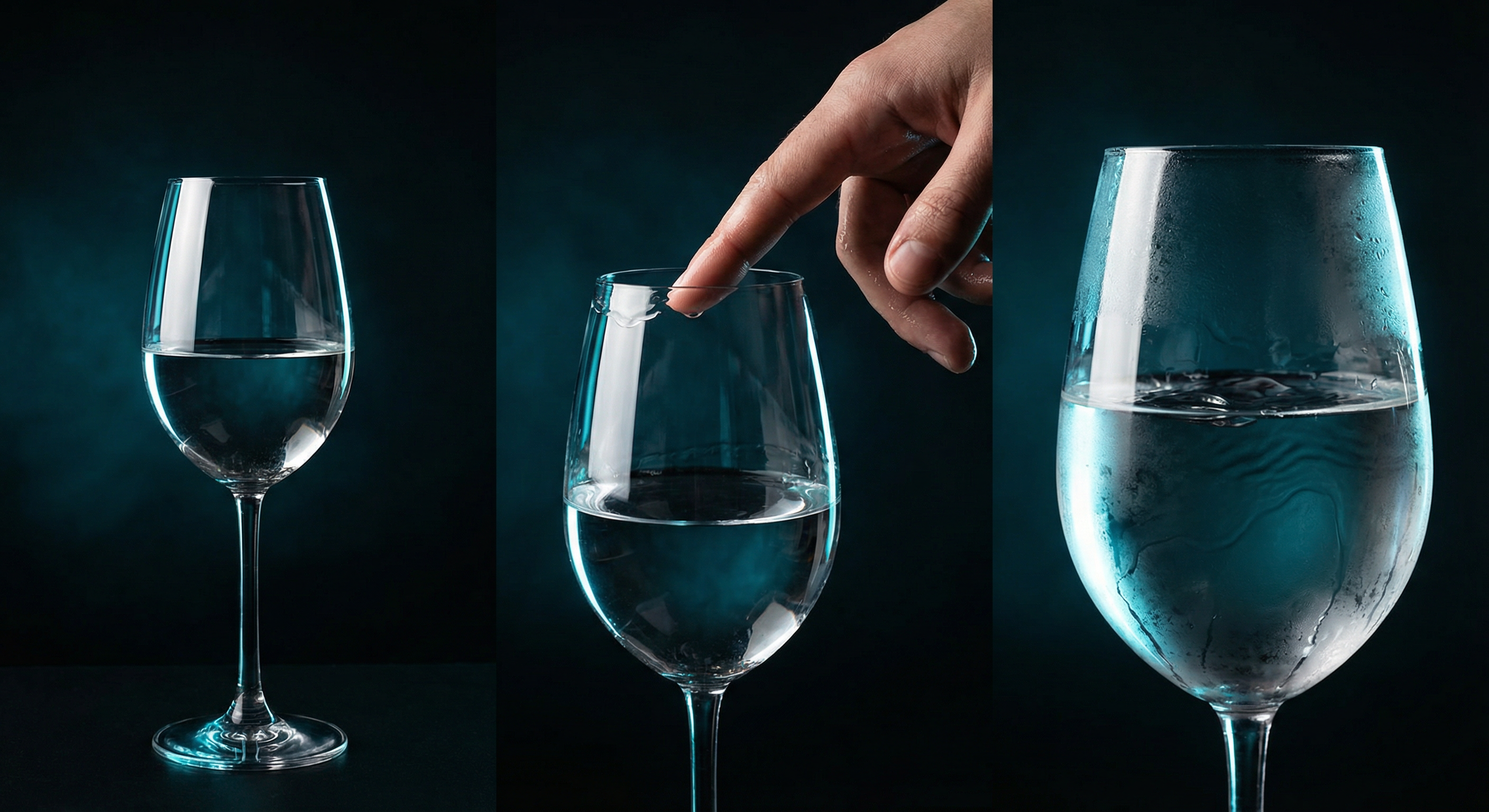 Key steps: clean rim → fill one-third → wet fingertip → draw around rim.
-
Select your glass. Tap the rim with a fingernail — a long, clear ring indicates low internal damping and strong resonance. Thick tumblers will barely sing; thin-walled crystal is ideal.
-
Clean the rim thoroughly with soap and water. Any grease or residue will lubricate the contact and prevent stick-slip excitation. Dry the glass, then moisten only your fingertip.
-
Fill the glass approximately one-third full with water. This is your baseline pitch. Record the frequency using your tuning app.
-
Place the glass on a stable, non-resonant surface — a folded towel dampens sympathetic vibration from the table. Ensure good lighting from the side to illuminate the water surface.
-
Optional: Add two drops of food coloring and position a strobe light or phone flashlight at a low angle across the water surface to reveal wave patterns.
Procedure
Phase 1 — Finding the Voice
Wet your fingertip and press it lightly against the rim. Draw it around the circumference at a slow, steady pace — not too fast, not too light. After one or two revolutions, the glass begins to sing. You are hearing the (2,0) flexural mode: the rim distorts into an ellipse, with four equally spaced points alternating between inward and outward displacement.
The glass does not vibrate where your finger touches — it vibrates everywhere else, and your finger feeds the silence back into song.
Watch the water: at the moment the tone stabilizes, fine ripples appear on the surface, organizing into concentric or radial patterns driven by the oscillating walls.
Phase 2 — Tuning with Water
Gradually add water. As the level rises, the resonant frequency drops — the added mass slows the vibration. Remove water and the pitch rises. Record frequency versus water height; the relationship is approximately linear for small changes. You are mapping the glass's dispersion curve against fluid loading.
Phase 3 — Higher Modes
Press more firmly and move your finger faster. With practice, you can excite the (3,0) mode — a higher pitch where the rim forms a triangular distortion with six nodal points. The water pattern changes correspondingly, showing a finer lattice. Some glasses will yield a (4,0) mode at still higher frequency, though it demands a very clean rim and precise finger pressure.
Phase 4 — The Shattering Point (Discussion)
At extreme amplitude, the flexural strain in the glass wall can exceed the material's tensile strength, and the glass explodes. Professional demonstrations use an external speaker and amplifier locked onto the resonant frequency, driving oscillations far beyond what a finger can achieve. The critical insight: shattering is not about volume — it is about resonance. A loud sound at the wrong frequency does nothing; a modest sound at the right frequency, sustained, can be catastrophic. This is the destructive face of the same physics that makes the glass sing.
Sources
- French, A.P. Vibrations and Waves. New York: W.W. Norton, 1971. Reprinted Cambridge, MA: MIT Press, 1983.
- Rossing, Thomas D. "Wine Glasses, Bell Modes, and Acoustic Radiation." The Physics Teacher 28, no. 9 (1990): 582–585.
- Jundt, Gilles, Massou, Arezki, et al. "Acoustics of Drinking Glasses and Wine Quality." Journal of the Acoustical Society of America 119, no. 6 (2006): 3793–3798.
- Franklin, Benjamin. "Letter to Giambatista Beccaria on the Glass Armonica." 1762. Reprinted in The Papers of Benjamin Franklin, vol. 10. Yale University Press.