Singing Sand Dunes
Certain desert sands emit a sustained, haunting tone when disturbed -- nature's own cymatics.
What You Learn
In 1295, Marco Polo crossed the Lop Desert and described sands that "at times fill the air with the sounds of all kinds of musical instruments, and also of drums and the clash of arms." He attributed the phenomenon to spirits. Seven centuries later, physicists are still debating the exact mechanism — but the sounds are real. Certain desert dunes, when disturbed by wind or footsteps, emit a sustained, low-frequency hum that can last for minutes and carry across kilometers. This is singing sand: granular matter that spontaneously generates coherent acoustic waves.
The phenomenon inverts the usual cymatic paradigm. In a Chladni plate experiment, an external frequency organizes passive particles. Here, the particles are the oscillator. When a layer of sand shears — grains sliding over grains — individual collisions synchronize through a feedback loop between the avalanche dynamics and the elastic response of the dune body. The result is a startlingly pure tone, typically between 70 and 110 Hz, governed by the scaling law f ≈ 0.4 × (g/d)^(1/2), where g is gravitational acceleration and d is the mean grain diameter. This is Chladni's law in reverse: the medium generates its own frequency.
This experiment teaches you the physics of granular acoustics and self-organized oscillation — how millions of incoherent grain collisions can lock into a collective vibration. You will learn why only certain sands sing (grain size uniformity, surface polish, silica content), how shear rate controls pitch and amplitude, and how the dune itself acts as a resonant cavity amplifying the signal. These principles connect to broader phenomena in condensed-matter physics, from earthquake dynamics to the acoustic emissions of grain silos.
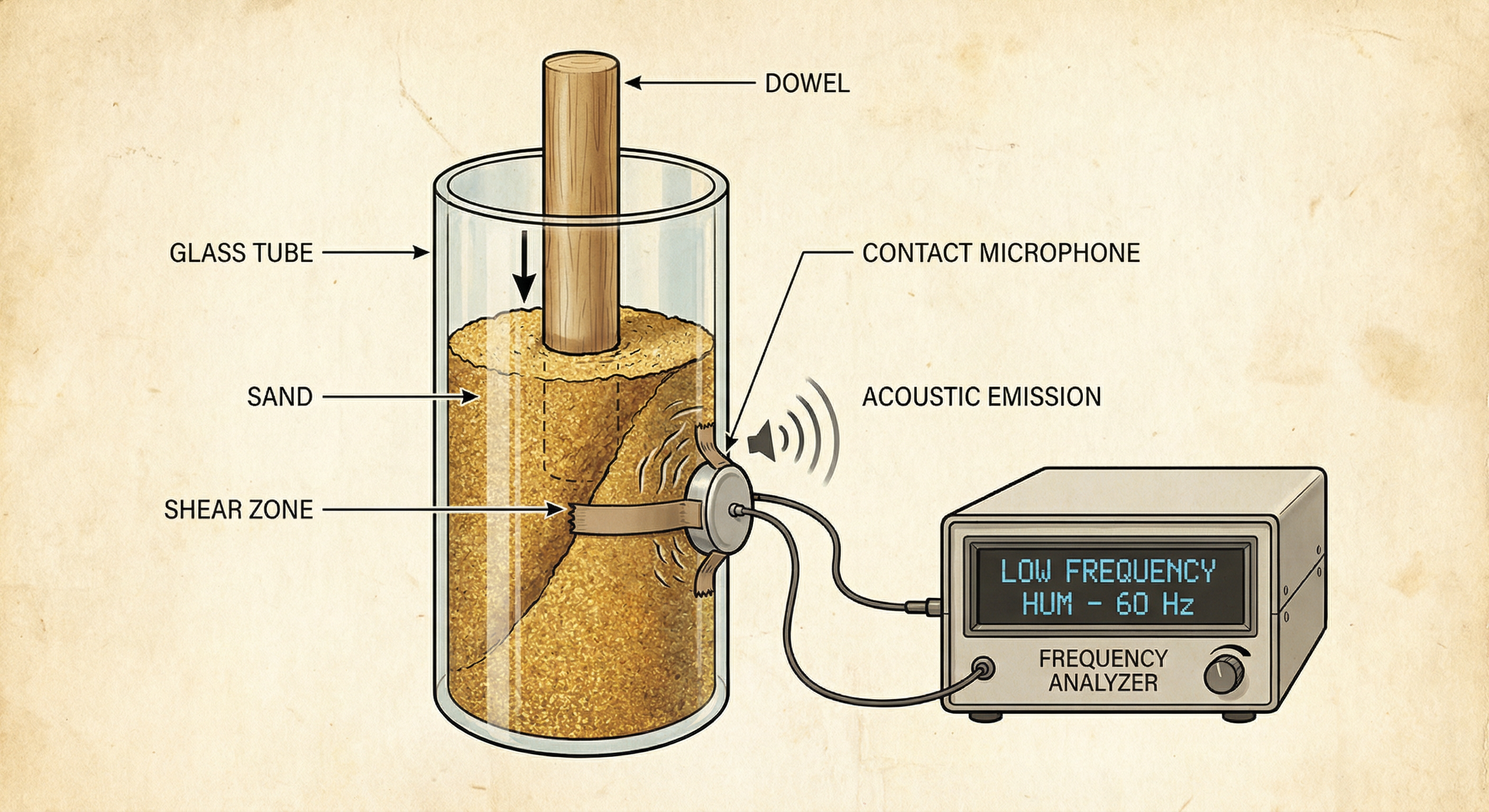 Acoustic emission — the avalanche synchronizes into coherent oscillation (70–110 Hz).
Safety
Safety rating: Green — No chemical or electrical hazards.
- Field work: If collecting singing sand in desert environments, observe standard field safety — sun protection, adequate hydration, and awareness of heat exposure. Travel with a partner and a charged phone.
- Lab reproduction: Sand grains can irritate eyes and airways. Wear safety goggles when pouring or shearing sand, and work in a ventilated area or wear a dust mask for prolonged sessions.
- Hearing: The emitted tones are low-frequency and moderate in level; hearing protection is not required but keep your microphone gain sensible to avoid amplifier feedback.
Materials
Singing Sand Sample
$10–25Desert sand known to produce acoustic emission — Saharan, Omani, or commercial singing sand.
Tip: Online suppliers sell verified singing sand; beach sand rarely works.
Links coming soonGlass Cylinder or Tube
$8–15Clear tube 30–60 cm tall, 5–8 cm diameter, for sand column shearing experiments.
Tip: A graduated cylinder works well and lets you control fill height precisely.
Links coming soonContact Microphone
$15–30Captures vibration directly from the sand column or container wall.
Tip: A piezo contact mic eliminates ambient noise and isolates the grain signal.
Links coming soonRecording & Analysis Software
FreeAudacity (free) or similar DAW with spectrogram view for frequency identification.
Tip: Use the spectrogram to measure the fundamental and check for harmonics.
Links coming soonSafety Goggles
$3–8Protects eyes during sand pouring and shearing.
Tip: Any splash-rated lab goggles are sufficient.
Links coming soonComparison Sand Samples
$3–10Non-singing sands of different grain sizes for controlled comparison.
Tip: Craft sand, beach sand, and playground sand provide a good range of grain diameters.
Links coming soonSetup
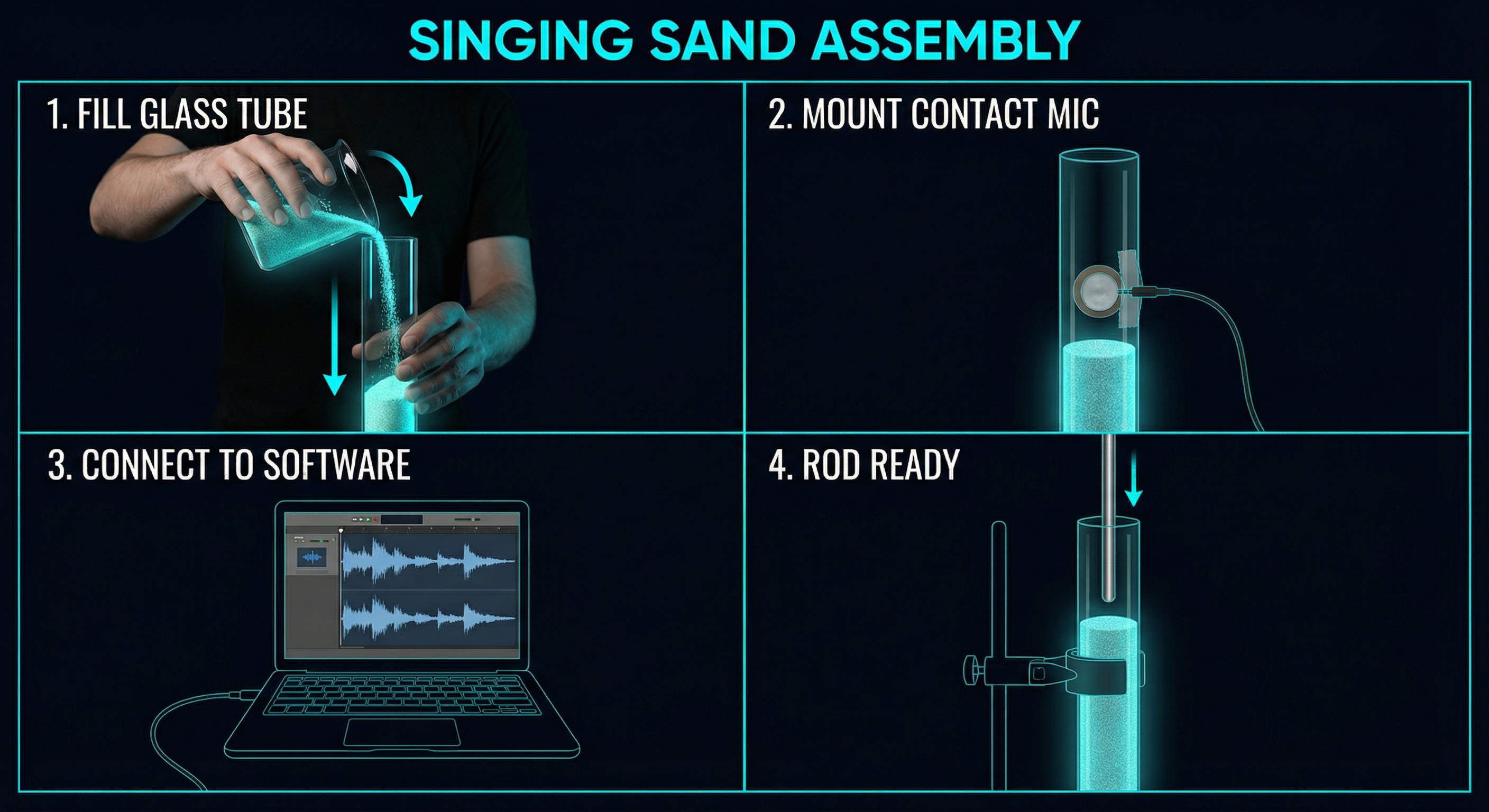 Key assembly steps: sand column → contact microphone → recording chain → shearing rod.
-
Prepare the sand column. Fill the glass tube to approximately two-thirds with singing sand. Tap the base gently to settle the grains into a loosely packed state — over-compaction suppresses the acoustic emission.
-
Mount the microphone. Attach the contact microphone to the exterior wall of the tube near the midpoint. If using a standard microphone, position it at the open top of the tube, 5–10 cm above the sand surface.
-
Connect the signal chain: Microphone → audio interface or direct input → recording software. Set input gain to a moderate level; you can always amplify later.
-
Prepare comparison samples. Fill identical containers with your non-singing sand samples at the same fill height. Label each with grain type and approximate diameter if known.
-
Calibrate your spectrogram. Open the spectrogram view in your recording software with a frequency range of 0–500 Hz and a window size of at least 2048 samples for good low-frequency resolution.
Procedure
Phase 1 — Shearing and Listening
Insert a flat rod or wooden dowel into the singing sand column and push it steadily downward at a moderate speed. As the rod shears through the grain pack, listen: you should hear a low, sustained hum — sometimes described as a groan or a cello note. Vary the shear rate (faster, slower) and note how the pitch and intensity change. Faster shearing generally raises both.
The sand does not simply grind — it sings, as if each grain were a throat and the avalanche a choir finding its unison.
Phase 2 — Recording and Analyzing
Record several shearing events of 3–5 seconds each. In your spectrogram view, identify the fundamental frequency — the bright horizontal band. Measure it. For typical singing sand with grain diameter d ≈ 200 µm, expect a fundamental near 90–100 Hz. Check for harmonic overtones (integer multiples of the fundamental) which indicate coherent, nearly periodic oscillation rather than broadband noise.
Calculate the predicted frequency using the scaling law: f ≈ 0.4 × √(g/d). Compare your measured value to the prediction. Discrepancies reveal the influence of grain shape, packing, and moisture content — parameters the simple scaling law ignores.
Phase 3 — Grain Size Comparison
Repeat the shearing procedure with each comparison sand sample. Most non-singing sands will produce only broadband scraping noise with no discernible pitch. On the spectrogram, this appears as a diffuse smear rather than a sharp spectral line. The contrast is striking and demonstrates that acoustic emission requires specific grain properties: uniform size, rounded shape, and a polished silica surface that permits synchronized elastic rebound.
Sources
- Andreotti, Bruno. "The Song of Dunes as a Wave-Particle Mode Locking." Physical Review Letters 93, no. 23 (2004): 238001.
- Douady, Stéphane, et al. "Song of the Dunes as a Self-Synchronized Instrument." Physical Review Letters 97, no. 1 (2006): 018002.
- Noureddine, Amir, et al. "Song of the Dunes: Grain Size and Desert Acoustics." Geophysical Research Letters 35 (2008): L07403.