Salt Mandala
Fine salt crystallizes into intricate mandala patterns, each one a unique fingerprint of the frequency that created it.
What You Learn
The Tibetan monks who sweep colored sand into geometric mandalas and then destroy them are enacting an ancient metaphor: form arises from vibration, persists for a moment, and dissolves. On a vibrating metal plate dusted with fine table salt, nature performs the same ritual in seconds. As the driving frequency rises into the upper hundreds and low thousands of hertz, the salt — finer-grained and lighter than the craft sand used in classical Chladni demonstrations — resolves modal structures that coarser media cannot reveal. The result is a series of increasingly intricate geometric mandalas, each one a unique fingerprint of a single pitch.
What makes salt special is its grain size. At roughly 0.1–0.3 mm, table salt particles are small enough to trace the tightly spaced nodal lines that appear above 1 kHz, where play sand begins to bridge across features and blur the image. The salt acts as a high-resolution sensor, mapping the zero-displacement contours of the plate's eigenmodes with surprising fidelity. You will learn to read these patterns as physicists and engineers do — as visual solutions to the biharmonic equation governing thin-plate vibration.
Historically, the connection between symmetry and sound was first made rigorous by Ernst Chladni in the late 18th century, but the mandala-like quality of higher-order modes was not widely appreciated until Hans Jenny's photographic studies in the 1960s. Jenny saw in these patterns a bridge between physics and aesthetics — proof that beauty is not imposed on nature but extracted from it by resonance. This experiment invites you to cross that same bridge, armed with a tone generator and a pinch of salt.
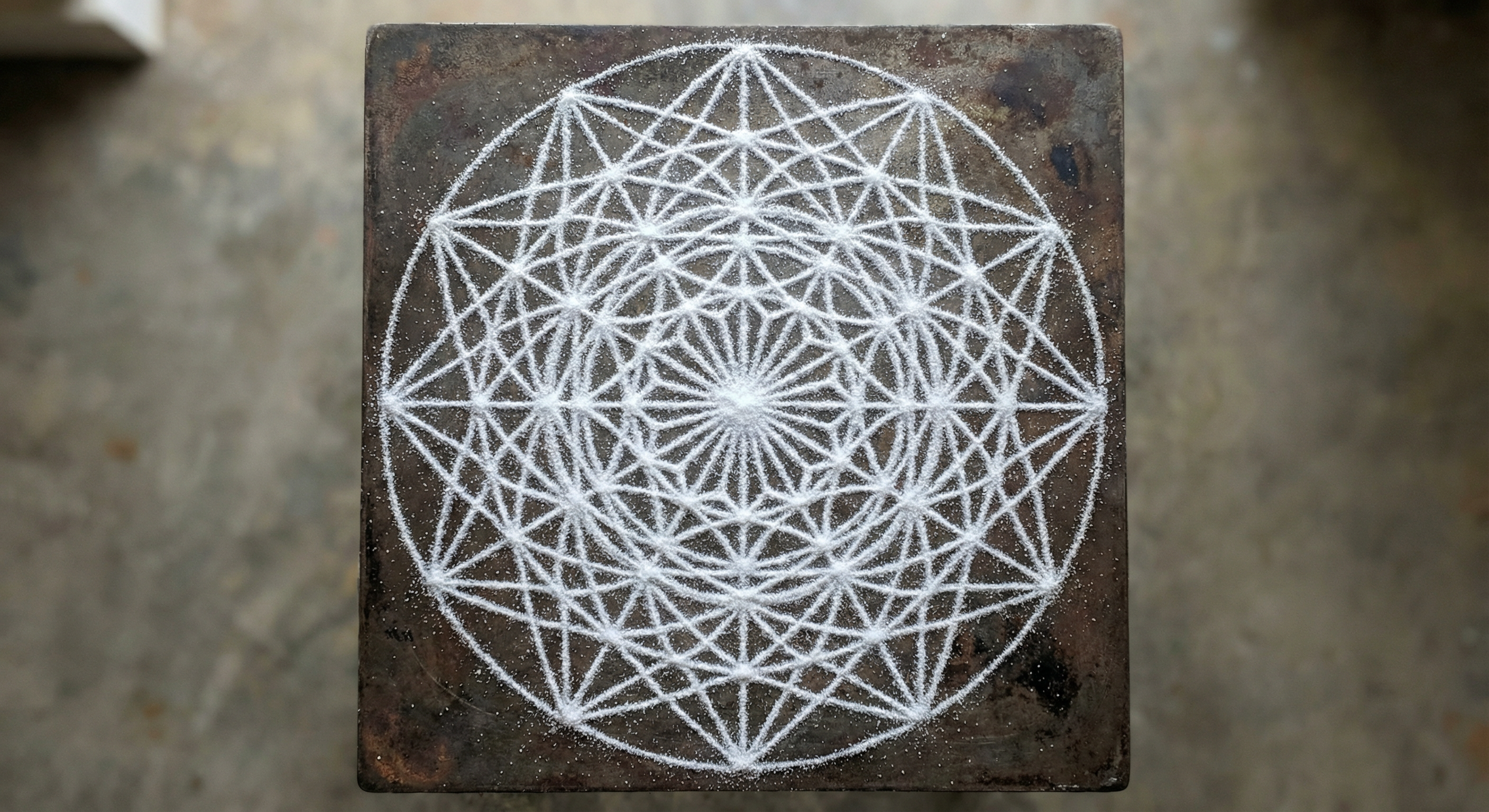 High-frequency modal mandala — salt traces nodal lines with fine-grained resolution.
Safety
- Ear protection recommended above 90 dB — high-frequency tones at volume can cause hearing fatigue or damage
- Fine salt can irritate eyes; avoid blowing across the plate surface
- Keep salt away from electronic equipment; stray grains can short unprotected circuits
- Wipe the plate clean between runs to prevent salt buildup from dampening resonance
Safety rating: Green — No significant hazards with normal precautions.
Materials
Fine Salt
$2–3Table salt or finely ground salt for high-resolution pattern tracing.
Tip: Finer grains resolve more detail at high frequencies.
Links coming soonThin Metal Plate
$10–30Square or circular plate, 20–30 cm, brass or aluminum 0.5–1 mm thick.
Tip: A smooth, unblemished surface ensures even salt distribution.
View OptionsSpeaker Driver
$10–25A small driver with a threaded post epoxied to the cone for plate coupling.
Tip: Ensure rigid coupling — any looseness absorbs energy and muddies the pattern.
View OptionsAmplifier
$20–405–20 W, enough to vibrate the plate clearly across the frequency range.
Tip: Start at low volume; salt scatters violently if you overdrive.
View OptionsTone Generator
FreeApp or software generating sine waves from 400 Hz to 4 kHz with fine resolution.
Tip: 1 Hz resolution lets you lock onto exact eigenfrequencies. tonegenerator.app works in the browser.
Try freeCentral Mount
$5–15A bolt or post supporting the plate at its geometric center.
Tip: A single contact point is essential — additional supports kill higher modes.
View OptionsSetup
 Key assembly steps: center mount → speaker coupling → sieve salt → ready.
-
Mount the plate at its center on a rigid post or bolt so all edges vibrate freely. Level the surface — salt migrates downhill on a tilted plate, obscuring the true nodal geometry.
-
Attach the speaker driver to the underside of the plate via a coupling post. The post should press firmly against the plate center; any gap or wobble will absorb energy and suppress higher-order modes.
-
Connect the signal chain: Tone generator → Amplifier → Speaker. Set volume to zero before powering on.
-
Dust the plate with a thin, even layer of fine salt. Use a tea strainer or fine-mesh sieve to distribute the grains uniformly — clumps create false nodal features.
-
Arrange side-lighting at a low angle to cast shadows along the salt ridges. A single LED flashlight works well; overhead light flattens the visual contrast.
Procedure
Phase 1 — First Symmetry
Set the tone generator to 400 Hz and slowly raise the amplitude. The salt will tremble, then stream purposefully toward the nodal lines — the silent scaffolding of the vibrating plate. At the first eigenfrequency you encounter, a simple mandala appears: broad lines dividing the plate into a few vibrating petals.
Salt seeks silence. What remains still is what the sound cannot reach.
Phase 2 — Ascending Complexity
Sweep the frequency upward in small increments. Each new eigenfrequency scatters the previous mandala and assembles a more intricate one in its place. Note the progression:
- 400–800 Hz: Simple crosses and low-order stars, with wide nodal spacing
- 800–2000 Hz: Dense, lattice-like mandalas with concentric rings and radial spokes
- 2000–4000 Hz: Filigree patterns of extraordinary delicacy — dozens of nodal lines woven into forms that recall snowflakes or cathedral rose windows
Photograph each pattern from directly above. Record the frequency to the nearest hertz. You are assembling a modal atlas of your plate.
Phase 3 — Reading the Geometry
Select three or four of your clearest mandalas and count their nodal diameters (radial lines through the center) and nodal circles (concentric rings). These two integers (m, n) uniquely identify each mode. Plot frequency against mode number and you will see the relationship Chladni himself first described: frequency rises roughly as the square of the combined mode indices.
Every mandala is an equation made visible — a solution the plate found on its own.
Phase 4 — The Dissolving Mandala
Choose a favorite pattern and hold it steady. Then, very slowly, detune the frequency by a few hertz. Watch the mandala soften, blur, and dissolve as the salt drifts between two competing geometries. This liminal moment — pattern becoming chaos becoming pattern — is the heart of cymatics, and of the mandala tradition itself: form is impermanent, born from resonance and erased by its absence.
Sources
- Chladni, E.F.F. Entdeckungen über die Theorie des Klanges. Leipzig: Weidmanns Erben und Reich, 1787.
- Jenny, Hans. Cymatics: A Study of Wave Phenomena and Vibration. Basel: Basilius Presse, 1967. Reprinted by MACROmedia, 2001.
- Rossing, Thomas D. "Chladni's Law for Vibrating Plates." American Journal of Physics 50, no. 3 (1982): 271–274.
- Tuan, P.H., et al. "Exploring the Resonant Vibration of Thin Plates: Reconstruction of Chladni Patterns and Determination of Resonant Wave Numbers." The Journal of the Acoustical Society of America 137, no. 4 (2015): 2113–2123.