Rice on Speaker Cone
Rice grains bounce and self-organize into shifting clusters, mapping the invisible pressure landscape of a speaker cone.
What You Learn
A speaker cone is a drumhead with a voice. When driven by a pure tone, it vibrates in patterns described by Bessel functions — the same mathematical solutions that govern the oscillation of circular membranes, the rings of Saturn, and the diffraction of light through a circular aperture. At low frequencies, the entire cone moves as a piston: up and down in unison. But as frequency rises, the cone fractures into concentric rings and radial sectors of opposing motion, separated by nodal lines where the surface stands still. These nodal lines are invisible — until you scatter rice across the cone.
Rice grains act as tracer particles, bouncing chaotically off the vibrating regions and tumbling into the quiet nodal zones where they cluster and rest. The transition is mesmerizing: what begins as apparent randomness — grains leaping wildly — resolves within seconds into organized rings and arcs. You are watching a physical system find its eigenmodes, the natural vibrational shapes permitted by the cone's geometry, tension, and boundary conditions.
This experiment is a gateway to understanding modal analysis — the engineering discipline that maps how structures vibrate. The same mathematics that describes rice settling on a speaker cone predicts how an aircraft fuselage resonates, how a bridge deck responds to wind, and how a violin top plate shapes its timbre. By sweeping frequency and watching the rice rearrange, you build physical intuition for concepts — standing waves, nodes, antinodes, and mode shapes — that are otherwise locked inside equations.
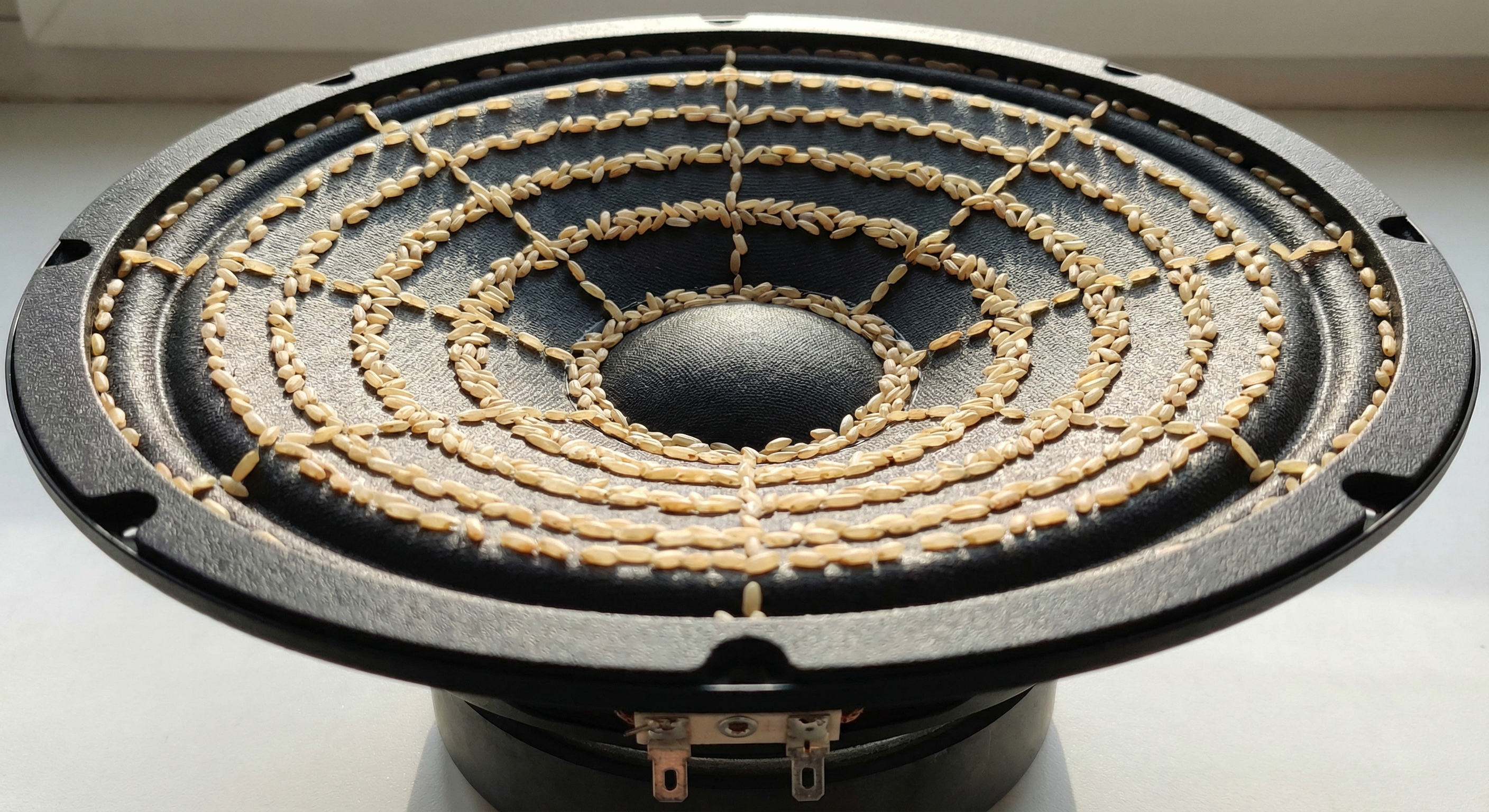 Bessel function mode — rice maps the invisible nodal geometry of the vibrating cone.
Safety
Safety rating: Green — No significant hazards.
- Protect the speaker cone. Use only dry, uncooked rice. Do not use hard, sharp, or heavy particles that could puncture the cone material.
- Moderate volume. Start at low amplitude and increase gradually. Excessive power can overdrive the cone and permanently deform the suspension. If the cone distorts visibly or the sound becomes harsh, reduce the level immediately.
- Hearing comfort. Sustained pure tones can be fatiguing. Keep the volume at a conversational level; ear protection is not required but reduces annoyance during long frequency sweeps.
Materials
Uncooked Rice
$1–3Lightweight tracer particles that bounce and cluster on the vibrating cone surface.
Tip: Standard long-grain white rice works best; short-grain is heavier and less responsive.
Links coming soonSpeaker Driver
$10–25A bare 6–10 inch woofer or full-range driver, mounted face-up.
Tip: A bare driver is essential — Bluetooth speakers have grilles that block access to the cone.
View OptionsAmplifier
$20–70Drives the speaker; 5–20 W is sufficient for visible cone motion.
Tip: A small desktop amplifier or old stereo receiver works perfectly.
View OptionsTone Generator
FreeApp or software producing sine waves from 50–300 Hz with fine frequency control.
Tip: Use 0.1 Hz steps near resonances to find the sharpest clustering patterns. tonegenerator.app works in the browser.
Try freePlastic Wrap
$2–3Optional: stretched over the cone to create a flat surface and protect the cone material.
Tip: Secure tightly with a rubber band; sagging wrap dampens the vibration.
Links coming soonTray or Newspaper
FreeCatches rice that bounces off the cone during high-amplitude phases.
Tip: Place the speaker in a shallow tray to keep your workspace clean.
Links coming soonSetup
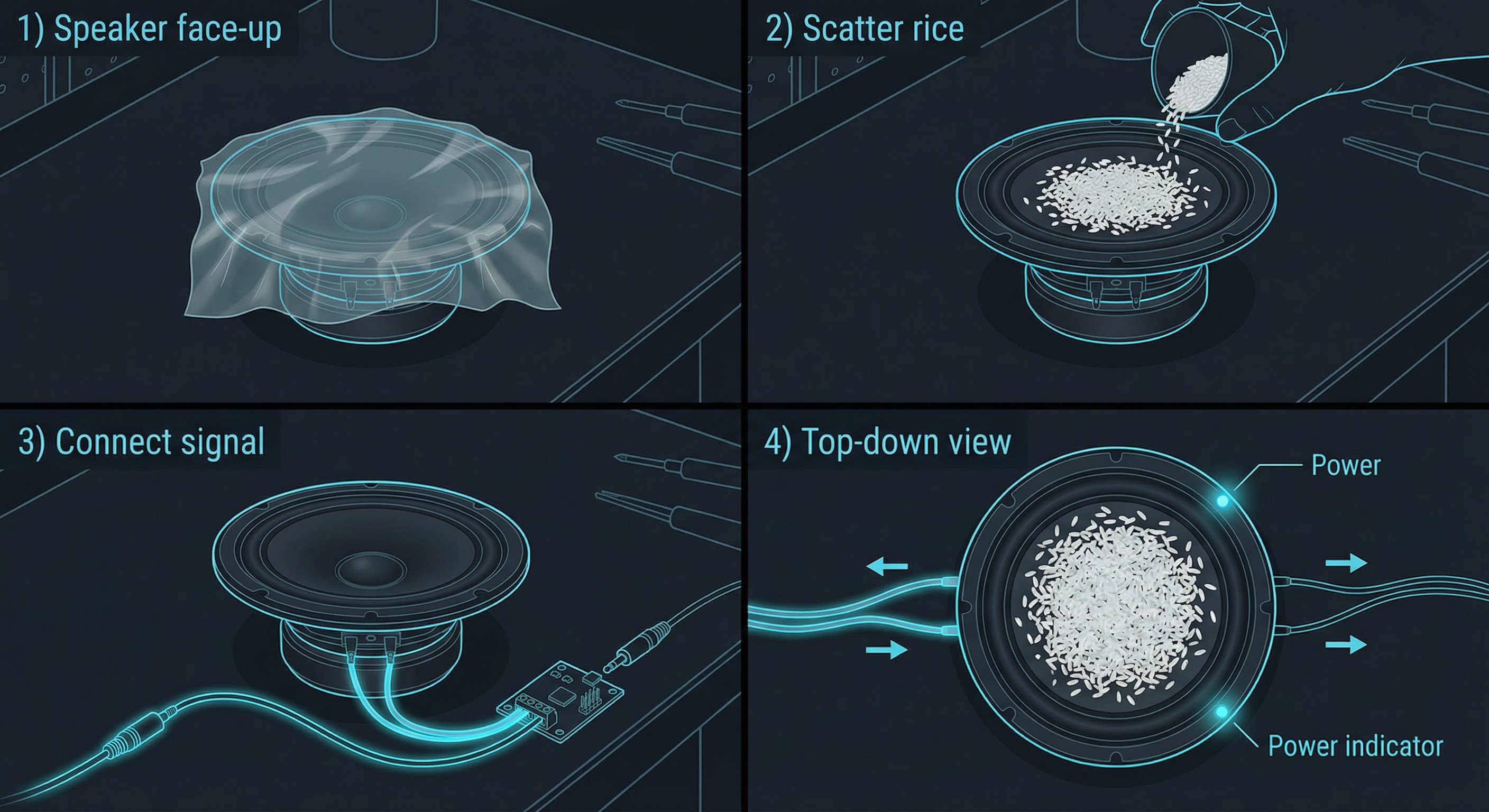 Key assembly steps: position speaker → optional plastic wrap → scatter rice → ready.
-
Position the speaker. Place the bare driver face-up on a flat, stable surface. If the speaker has mounting holes, secure it to a board or frame to prevent it from walking during operation.
-
Optional: apply plastic wrap. Stretch a layer of cling wrap tightly across the cone and secure it with a rubber band around the basket rim. This creates a flat, protected surface. The wrap must be taut — any slack kills the higher-order modes.
-
Connect the signal chain: Tone generator → Amplifier → Speaker. Set the amplifier volume to zero before powering on.
-
Scatter rice. Sprinkle a thin, even layer of rice across the cone surface — roughly one grain deep. Too many grains damp the vibration; too few leave gaps in the pattern.
-
Arrange your viewpoint. Position yourself or a camera directly above the speaker. Top-down viewing reveals the nodal geometry most clearly. Side-lighting from a desk lamp enhances the contrast of the grain clusters.
Procedure
Phase 1 — Low-Frequency Bouncing
Set the tone generator to 50 Hz and slowly raise the volume. The cone moves as a piston at this frequency, and the rice grains begin to bounce uniformly — a miniature popcorn effect. There are no nodal lines yet; the entire surface is an antinode. Note how the bounce height increases with amplitude. This is the regime where the speaker behaves as a simple oscillator.
At first the rice leaps without purpose — a hundred tiny bodies obeying nothing but gravity and the blind rhythm of the cone.
Phase 2 — Finding Clusters
Increase the frequency slowly toward 100–150 Hz. At a certain pitch, the bouncing becomes uneven: grains near the center may calm while those at the edge leap higher, or vice versa. Then — suddenly — the rice organizes. Grains stream away from the vibrating zones and collect along the nodal lines in concentric rings or radial arcs. You have found a cone mode. Adjust frequency in small steps (0.5–1 Hz) to sharpen the pattern to maximum clarity.
Record the frequency and photograph the pattern from above. This is a direct, physical map of a Bessel function solution for the circular membrane.
Phase 3 — Frequency Sweep
Sweep from 50 Hz to 300 Hz in increments of 5 Hz, pausing wherever the rice shows clear clustering. You will find several distinct mode shapes:
- First radial mode: A single nodal ring dividing center from edge
- Second radial mode: Two concentric rings
- Azimuthal modes: Radial lines dividing the cone into pie-slice sectors
- Combined modes: Rings and radial lines producing a grid of nodal cells
At higher frequencies, the patterns grow finer and more intricate, mirroring the higher-order Bessel functions. Document each mode with its frequency and photograph.
Phase 4 — Grain Size Comparison
Replace the long-grain rice with other particles — short-grain rice, couscous, salt, or fine sand — and repeat selected frequencies. Lighter, smaller particles respond to weaker vibrations and resolve finer nodal detail. Heavier grains require more power but remain stable in the nodal zones against air currents. Compare how grain mass and size affect the minimum amplitude needed for pattern formation and the sharpness of the nodal boundaries.
Sources
- Fletcher, Neville H., and Rossing, Thomas D. The Physics of Musical Instruments. 2nd ed. New York: Springer, 1998.
- Kinsler, Lawrence E., et al. Fundamentals of Acoustics. 4th ed. New York: Wiley, 2000.
- Tyndall, John. Sound: A Course of Eight Lectures Delivered at the Royal Institution of Great Britain. London: Longmans, Green, 1867.