Laser Membrane Patterns
A laser bouncing off a vibrating membrane traces ghostly Lissajous figures in real time.
What You Learn
In 1826, the German physicist Johann Christian Poggendorff devised the optical lever — a mirror mounted on a moving element so that even the smallest angular deflection is amplified into a large sweep of a reflected light beam. A century later, Lord Kelvin adapted the technique for his mirror galvanometers, turning imperceptible electrical currents into visible traces across a darkened laboratory wall. The principle is elegant: the beam travels far, so the arc it traces magnifies the mirror's tilt by the ratio of throw distance to lever arm. A membrane displacement of a fraction of a millimetre becomes a luminous stroke spanning metres.
When a small mirror is fixed to the surface of a speaker-driven membrane, a laser reflected from that mirror paints a real-time record of the membrane's motion on a distant wall. At a single frequency the trace is a simple line or ellipse — the beam rocks back and forth in the plane of vibration. But when two perpendicular oscillations combine (one from the membrane, the other from a slight tilt or a second driver), the beam weaves Lissajous figures: looping, braided curves whose shape encodes the frequency ratio and phase relationship between the two oscillations.
Jules Antoine Lissajous first described these curves in 1857 using tuning forks and mirrors. What you will recreate here is essentially his original experiment translated into the age of coherent light. The patterns are parametric curves — each point on the trace is defined by x(t) = A sin(at + δ) and y(t) = B sin(bt), where a/b is the frequency ratio and δ is the phase offset. Rational ratios produce closed loops; irrational ratios produce figures that never quite repeat, filling the projection surface with a shimmering, almost organic filigree.
This experiment teaches you to see vibration not as something heard but as something drawn — light as the pencil, sound as the hand.
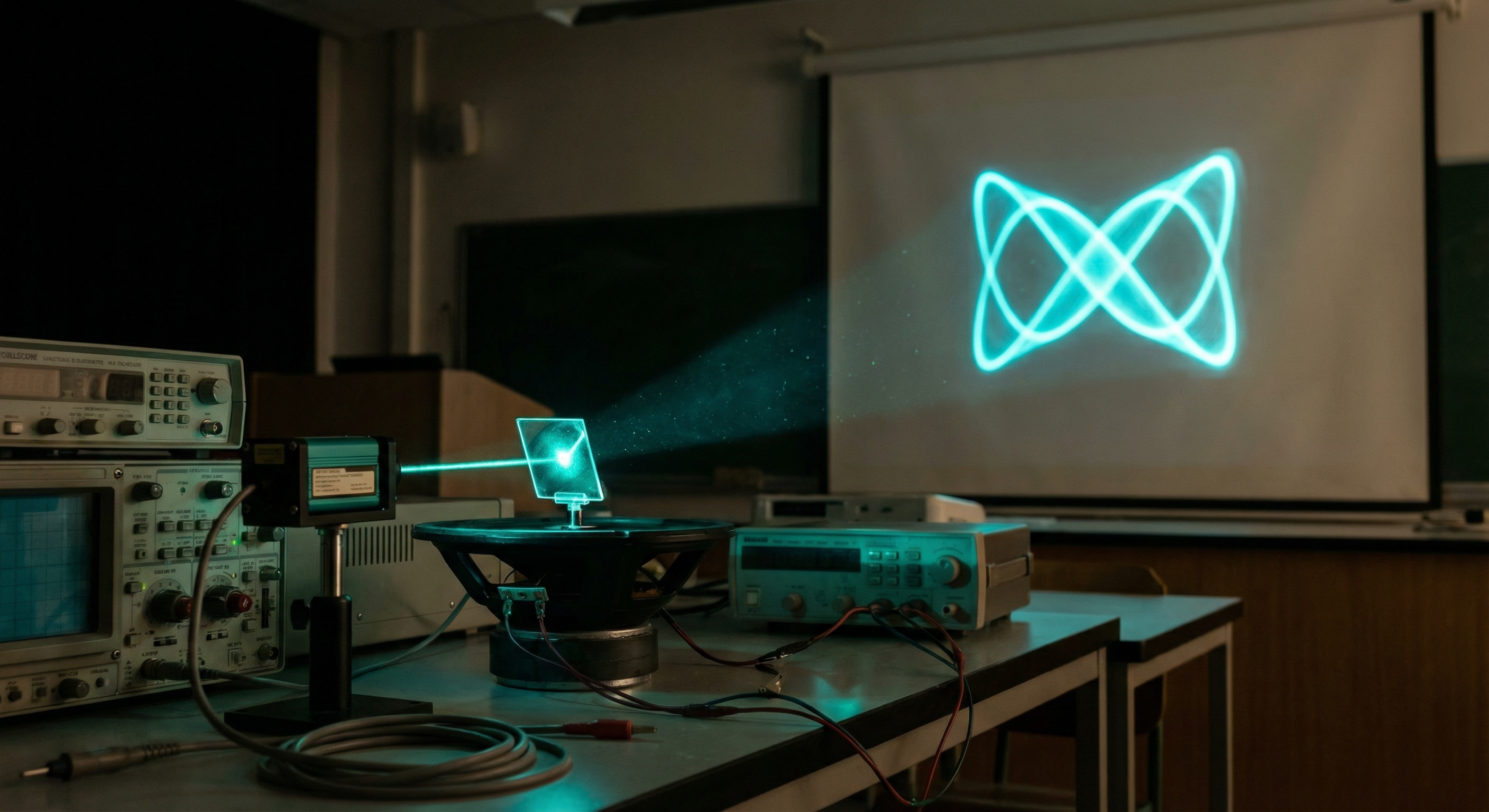 Lissajous trace at 1:2 frequency ratio — consonance made visible in light.
Safety
Safety rating: Yellow — Laser hazard requires specific precautions.
- Never look directly into the laser beam or into any specular (mirror-like) reflection
- Use a Class 2 laser (≤ 1 mW) for casual experimentation — the blink reflex provides adequate protection for momentary exposure
- For Class 3R or 3B lasers, all participants must wear appropriate laser safety goggles rated for the laser's wavelength
- Control the reflected beam path — know where the beam terminates at all times; a vibrating mirror creates a sweeping beam that can unexpectedly reach eyes
- Keep all bystanders behind the laser, never downrange of the beam or its reflections
- Remove or cover reflective surfaces (watches, jewellery, glass frames) in the beam's vicinity
- Work in a controlled, darkened room so stray reflections are visible against walls rather than lost in ambient light
Materials
Laser Pointer
$8–15Class 2 red or green laser module (≤ 1 mW). Green (532 nm) is more visible.
Tip: A fixed-mount module is steadier than a handheld pen.
Links coming soonSmall Mirror
$2–5Lightweight first-surface mirror, 5–10 mm diameter.
Tip: Craft mirrors work if the reflective coating is on the front face.
Links coming soonSpeaker
$8–20A 3–5 inch full-range driver with an exposed cone.
Tip: A bare driver gives the best access for mounting the mirror.
View OptionsAmplifier
$20–70Drives the speaker cleanly across 50–500 Hz; 5–20 W is sufficient.
Tip: Avoid clipping — distortion adds spurious harmonics to the trace.
View OptionsTone Generator
FreeApp or software producing precise sine waves with 0.1 Hz resolution.
Tip: Dual-tone mode lets you superimpose two frequencies for Lissajous figures. tonegenerator.app works in the browser.
Try freeMounting Putty
$3–5Adhesive putty to fix the mirror to the speaker cone center.
Tip: Use the minimum amount — extra mass dampens high-frequency response.
Links coming soonLaser Safety Goggles
$15–30OD 2+ goggles rated for your laser wavelength.
Tip: Required for Class 3+ lasers; good practice even with Class 2.
Links coming soonSetup
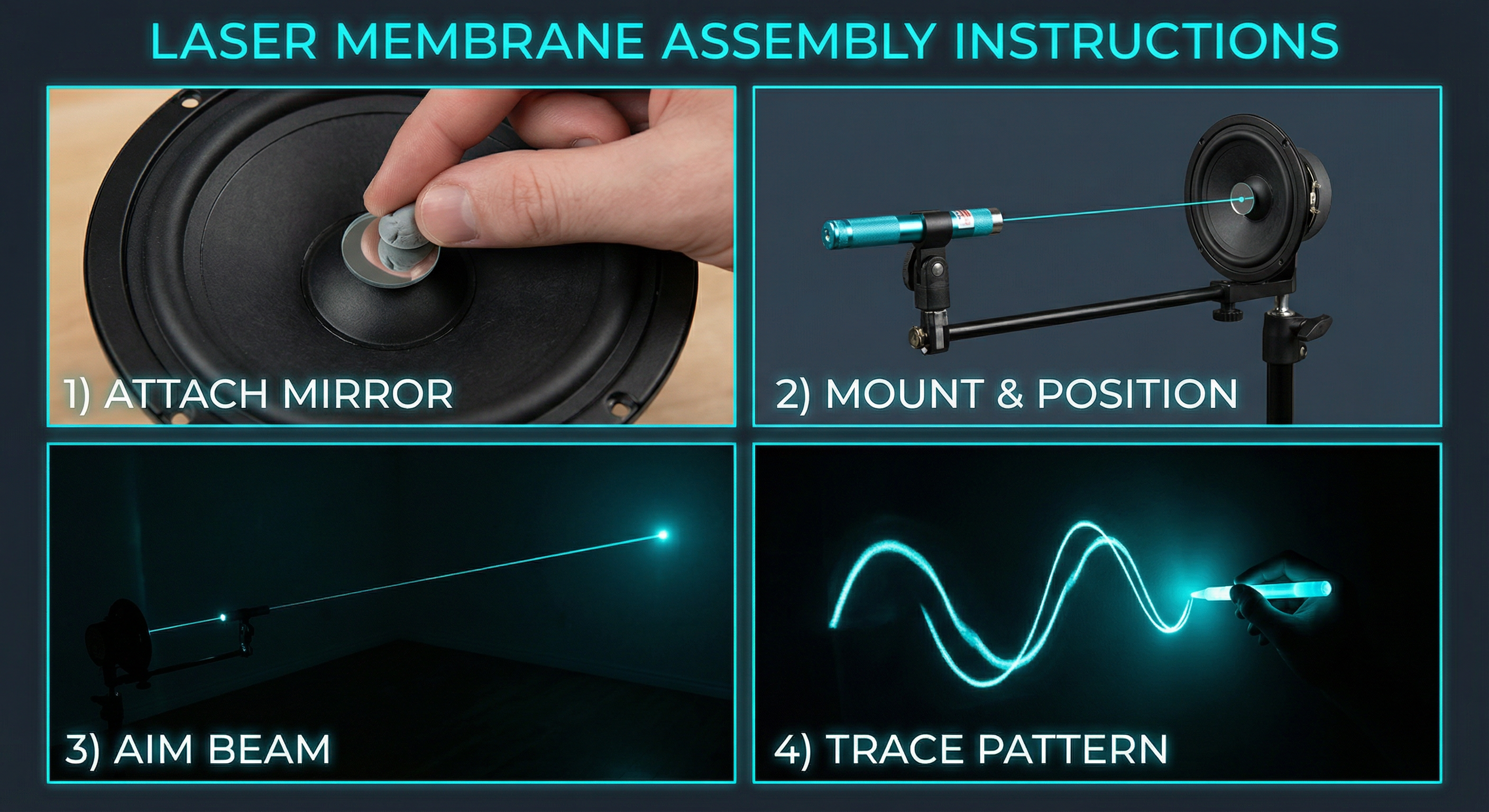 Key assembly steps: mirror → laser angle → beam to wall → darkened room.
-
Attach the mirror to the speaker cone. Place a small ball of mounting putty at the centre of the cone and press the mirror into it, reflective face outward. Ensure it is firmly seated but not so heavy as to overdamp the cone's motion.
-
Mount the speaker face-up or at a slight angle on a stable surface. The mirror must be accessible to the laser beam.
-
Position the laser so that it strikes the mirror at a shallow angle of incidence (~15–30°). Clamp or mount the laser firmly — any wobble in the source becomes noise in the trace.
-
Aim the reflected beam at a distant wall or white screen, ideally 2–4 metres away. The longer the throw, the greater the magnification of the membrane's vibration.
-
Darken the room. Lissajous traces are faint calligraphy; ambient light drowns them. Blackout curtains or simply waiting for nightfall both work.
-
Connect the signal chain: Tone generator → Amplifier → Speaker. Start with the volume at zero.
Procedure
Phase 1 — Single-Frequency Traces
Set the tone generator to 100 Hz and slowly raise the amplitude. The laser dot on the wall stretches into a luminous line — the beam rocking in the plane of the mirror's tilt. Sweep from 50 Hz to 500 Hz and observe how the line length changes with frequency: at the speaker's resonance the trace is longest, above and below it the amplitude falls. You are mapping the frequency response of the speaker-mirror system in light.
Phase 2 — Lissajous Figures
Switch to a dual-tone output: drive the speaker with two superimposed sine waves. Begin with a perfect 1:2 ratio (e.g., 100 Hz and 200 Hz). The trace curls into a figure-eight or bow-tie — a closed Lissajous loop. Try 2:3, 3:4, and 1:1 ratios. Each rational ratio produces a distinct, stable knot of light. The number of horizontal and vertical tangencies reveals the ratio directly.
The beam draws what the ear hears as harmony — consonance made visible.
Phase 3 — Detuning and Phase Effects
Starting from a clean 1:2 ratio, slowly detune one frequency by a fraction of a hertz. The closed loop begins to drift, its shape rotating and morphing as the phase relationship between the two oscillations continuously shifts. At exact rational ratios the figure is frozen; at near-rational ratios it breathes, cycling through every possible phase offset. This rolling motion is the optical signature of beating between two close frequencies — the same phenomenon the ear perceives as a slow waver in pitch.
Sources
- Lissajous, Jules Antoine. "Mémoire sur l'étude optique des mouvements vibratoires." Annales de chimie et de physique 51 (1857): 147–231.
- Rigden, John S. Physics and the Sound of Music. 2nd ed. New York: John Wiley & Sons, 1987.
- Poggendorff, Johann Christian. "Über eine Vorrichtung zur Vervielfältigung der Ablenkung der Galvanometernadel." Annalen der Physik 82, no. 7 (1826): 281–292.
- Whitaker, Robert J. "Harmonographs. I. Pendulum Design." American Journal of Physics 69, no. 2 (2001): 162–173.