Ferrofluid Resonance
Magnetic fluid erupts into alien topographies as sound waves sculpt its surface.
What You Learn
Ferrofluid is a colloidal suspension of nanoscale ferromagnetic particles (~10 nm diameter) coated in surfactant and suspended in a carrier oil. Place it near a magnet and it bristles into spikes — the normal-field instability first described by Ronald Rosensweig in 1985. Now add sound, and those spikes begin to dance, merge, split, and reform in rhythm with the driving frequency.
This experiment teaches you:
- The physics of ferrohydrodynamics — how magnetic body forces compete with surface tension and gravity
- The Rosensweig instability: when the magnetic force at the fluid surface exceeds the restoring force of surface tension plus gravity, the flat surface becomes unstable and erupts into a regular lattice of peaks
- How acoustic vibration modulates an already-unstable magnetic surface, creating time-varying topographies
- The interplay between parametric excitation (vertical vibration) and static instability (magnetic field)
The spike spacing follows a characteristic wavelength determined by the balance of magnetic pressure, surface tension, and gravitational potential. When you add vibration, you introduce a periodic forcing that can either reinforce or suppress the instability depending on frequency and amplitude — a rich nonlinear dynamical system in a petri dish.
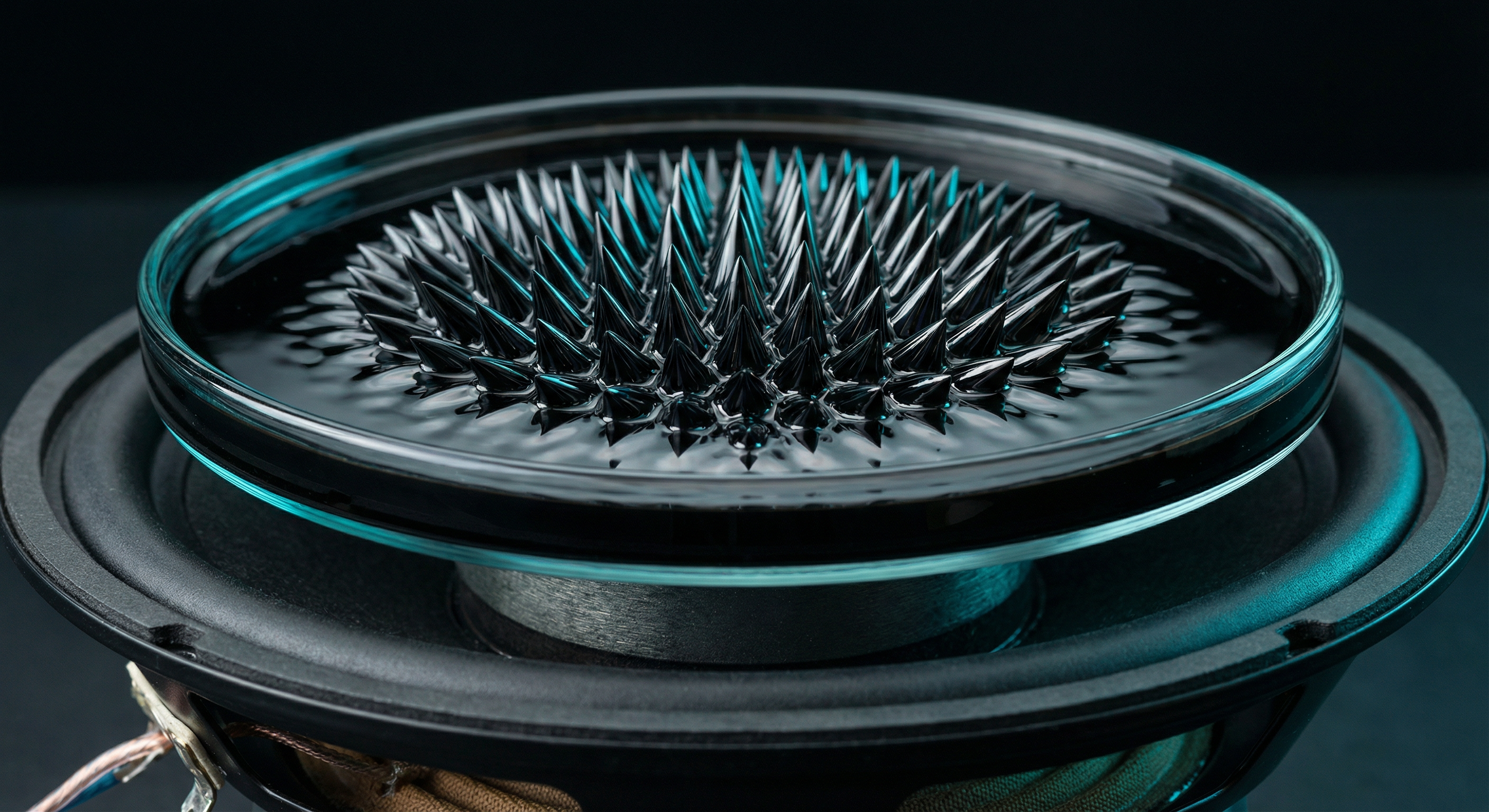 Rosensweig instability — spikes dance and merge in rhythm with the driving frequency.
Safety
Safety rating: Yellow — Ferrofluid is non-toxic but requires careful handling.
- Ferrofluid stains are permanent. It will ruin clothing, skin (temporarily), and porous surfaces irreversibly. Wear nitrile gloves and protect all nearby surfaces with disposable sheeting.
- Neodymium magnets are powerful. Magnets rated N42 or higher can pinch skin severely and shatter if they collide. Keep fingers clear of pinch points. Store magnets away from electronics, credit cards, and pacemakers.
- Do not ingest ferrofluid. While the carrier oil is typically low-toxicity, the nanoparticles are not food-safe.
- Ventilation: Some ferrofluids use volatile carrier solvents. Work in a ventilated area.
- Cleanup: Use isopropyl alcohol and paper towels. Dispose of contaminated materials responsibly.
Materials
Ferrofluid
$15–2550–100 mL educational-grade ferrofluid (e.g., EFH-1 from Ferrotec).
Tip: Oil-based formulations are less messy than water-based.
Links coming soonNeodymium Magnet
$5–15N42 or stronger, disc or cylinder shape, 20–40 mm diameter. Provides the static magnetic field.
Tip: Adjust distance to control spike height: closer means taller spikes.
Links coming soonSubwoofer or Large Speaker
$10–25Capable of clean output at 20–120 Hz. A 6-inch or larger driver works well.
Tip: A bare driver works better than an enclosed speaker for this setup.
View OptionsAmplifier
$20–70Sufficient to drive the speaker at moderate volume.
Tip: Start at zero volume and increase slowly.
View OptionsTone Generator
FreeApp or software producing sine waves with 0.1 Hz resolution.
Tip: Precise frequency control reveals subtle resonant behaviors. tonegenerator.app works in the browser.
Try freeShallow Glass Dish
$3–10Petri dish or small glass bowl to contain the ferrofluid on the speaker.
Tip: A small dot of mounting putty prevents the dish from wandering.
Links coming soonPlastic Wrap
$2–3Protects the speaker cone from ferrofluid contact.
Tip: Must be taut — any slack will dampen acoustic coupling.
Links coming soonNitrile Gloves
$5–8Essential — ferrofluid stains skin for days.
Tip: Put gloves on before opening the ferrofluid bottle.
Links coming soonDisposable Surface Covering
$2–3Plastic sheeting or newspaper beneath the entire setup.
Tip: Ferrofluid stains are permanent on porous surfaces.
Links coming soonIsopropyl Alcohol + Paper Towels
$2–3For cleaning up ferrofluid after the experiment.
Tip: Have alcohol and paper towels within reach before starting.
Links coming soonSetup
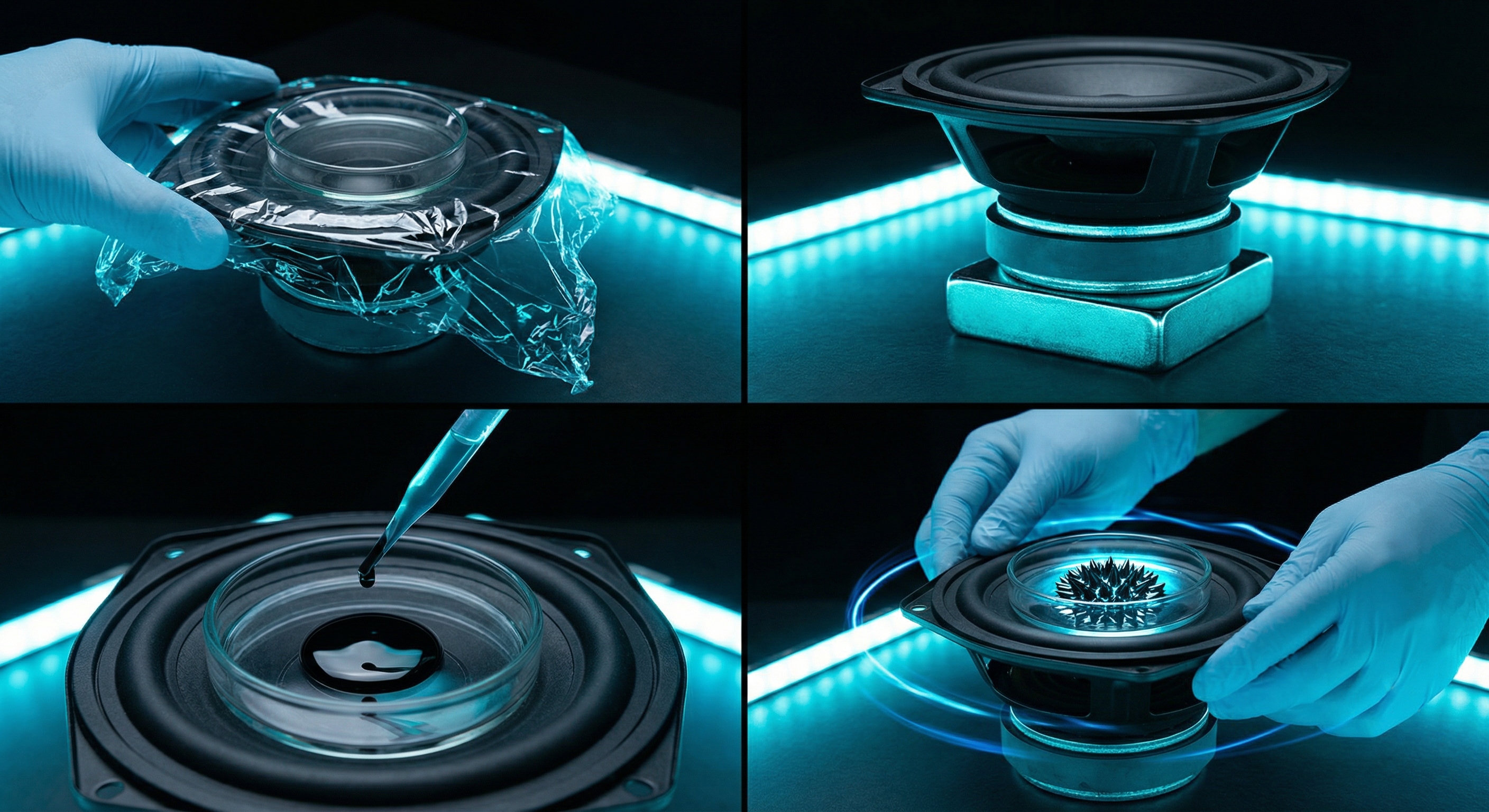 Key assembly steps: plastic wrap → dish → magnet below → ferrofluid pool. Wear gloves.
-
Protect the speaker. Stretch plastic wrap tightly over the speaker cone, securing it around the edges with tape. The wrap must be taut — any slack will dampen the acoustic coupling.
-
Place the glass dish on the center of the wrapped speaker cone. A small dot of mounting putty can prevent it from wandering.
-
Position the neodymium magnet directly beneath the speaker (under the cone, centered). The magnet should be close enough that its field reaches the dish — typically 2–5 cm from the fluid surface. Adjust distance to control spike height: closer = taller spikes, more dramatic response.
-
Add ferrofluid to the dish — a pool about 3–5 mm deep. You should immediately see the fluid respond to the magnet, forming a mound or initial spike pattern.
-
Connect your signal chain: Tone generator → Amplifier → Speaker. Start with volume at zero.
-
Cover your workspace and put on gloves before opening the ferrofluid bottle. Have alcohol and paper towels within reach.
Procedure
Phase 1 — Static Instability
Before turning on any sound, observe the ferrofluid in the magnetic field alone. Move the magnet closer and farther from the dish. Notice the critical distance at which the smooth surface suddenly breaks into spikes — this is the onset of the Rosensweig instability. The spike pattern is typically hexagonal, with spacing determined by the capillary length of the fluid modified by the magnetic Bond number.
Phase 2 — Adding Vibration
Set your tone generator to 40 Hz and slowly increase the amplitude. The spikes will begin oscillating vertically. At certain drive levels, you will see:
- Subharmonic response: Spikes oscillate at half the driving frequency
- Spike merging and splitting: Adjacent spikes combine or divide as the acoustic energy redistributes the surface
- Pattern rotation: The hexagonal lattice may rotate or shift to a square lattice under strong forcing
The fluid remembers the magnet's geometry but dreams in the frequency of sound.
Phase 3 — Frequency Sweep
Sweep slowly from 20 Hz to 120 Hz. Different frequencies will excite different spatial modes on the fluid surface. Low frequencies (~20–40 Hz) produce large, slow oscillations. Higher frequencies (~80–120 Hz) create finer surface textures and faster dynamics. Note which frequencies produce the most dramatic visual effects — these are the resonant frequencies of your particular dish-fluid-magnet system.
Phase 4 — Amplitude Response
At a fixed resonant frequency, slowly increase amplitude from zero to maximum. Document the progression:
- Sub-threshold: Spikes quiver but maintain their static arrangement
- Onset: Spikes begin large-amplitude oscillation
- Nonlinear regime: Spikes eject droplets, merge, form transient bridges between peaks
- Chaotic regime: The surface becomes turbulent, with no repeatable pattern
This amplitude progression mirrors many nonlinear systems — from gentle perturbation through bifurcation to chaos.
Sources
- Rosensweig, R.E. Ferrohydrodynamics. Cambridge: Cambridge University Press, 1985. Reprinted by Dover, 2014.
- Cowley, M.D., and Rosensweig, R.E. "The Interfacial Stability of a Ferromagnetic Fluid." Journal of Fluid Mechanics 30, no. 4 (1967): 671–688.
- Richter, Reinhard, and Barashenkov, Igor V. "Two-Dimensional Solitons on the Surface of Magnetic Fluids." Physical Review Letters 94, no. 18 (2005): 184503.