Cornstarch on Speaker
A non-Newtonian fluid defies gravity, rising into finger-like tendrils driven by bass frequencies.
What You Learn
Mix cornstarch and water in roughly equal parts and you create oobleck — a shear-thickening non-Newtonian fluid whose viscosity increases under stress. Tap it and it resists like a solid. Let your finger sink slowly and it yields like honey. This dual nature, first studied rigorously in the context of concentrated particle suspensions, makes oobleck one of the most visually dramatic materials you can place on a vibrating surface.
When oobleck sits on a speaker cone driven at bass frequencies (30–80 Hz), the periodic acceleration of the cone surface subjects the fluid to rapid shear cycles. At each upward stroke, the fluid compresses and momentarily solidifies, forming structures that persist just long enough to be visible before the next cycle liquefies them again. The result is a roiling, alien landscape of finger-like tendrils that appear to grow, reach, and grasp at the air — as if the fluid were alive and trying to escape.
This experiment teaches you:
- Non-Newtonian fluid mechanics: The difference between shear-thinning (ketchup, paint) and shear-thickening (cornstarch suspensions) behavior, and why particle volume fraction is the critical variable
- Shear thickening under oscillatory stress: How periodic forcing at audio frequencies drives the suspension through rapid solid-liquid transitions dozens of times per second
- Faraday instability in complex fluids: The same parametric instability that creates standing waves in water produces far more dramatic structures in a non-Newtonian medium because the fluid's effective viscosity changes mid-cycle
- The role of particle jamming: At high shear rates, cornstarch particles (~15 µm diameter) form transient force chains that resist deformation — the same "jamming" physics that lets you run across a pool of oobleck without sinking
The scientific literature calls this a discontinuous shear thickening (DST) suspension. The transition from fluid to solid behavior is not gradual but sharp — above a critical stress, viscosity can increase by orders of magnitude in milliseconds. On a vibrating speaker, this transition is what sculpts the liquid into structures that momentarily defy gravity.
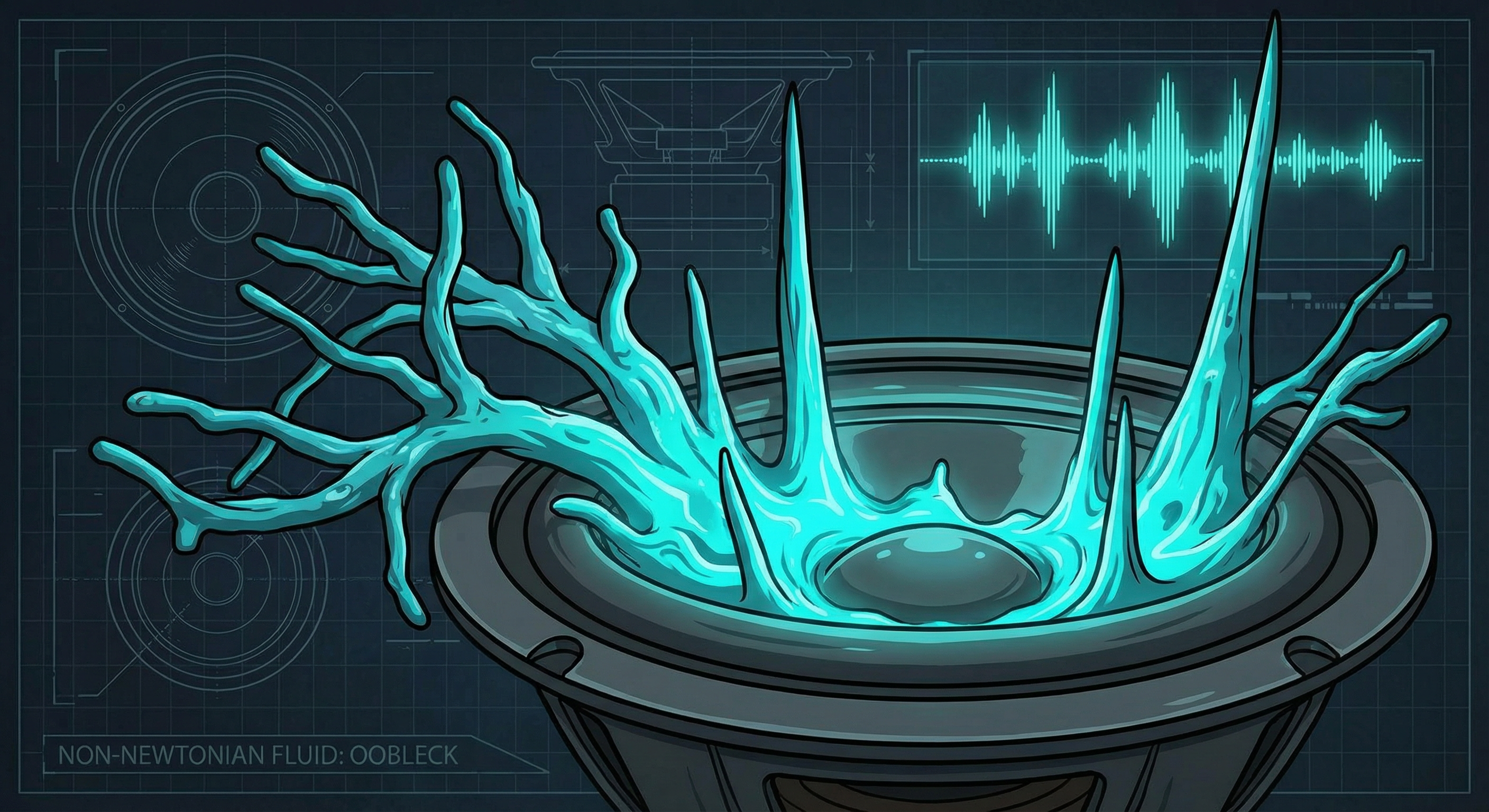 Oobleck at resonant frequency — shear thickening produces rising tendrils that defy gravity.
Safety
- No significant hazards — cornstarch and water are kitchen-safe ingredients
- Protect the speaker cone with plastic wrap; cornstarch paste is difficult to clean from paper cones and will damage the driver if it seeps into the voice coil gap
- Cornstarch dust can irritate airways if inhaled in quantity — mix the oobleck in a well-ventilated area or outdoors, and avoid creating dust clouds
- The mixture is slippery when spilled on floors — clean up promptly
- Extended high-amplitude speaker use can overheat the voice coil; take breaks every few minutes at high volume
Safety rating: Green — Edible ingredients, no fire, no chemicals, no electrical hazards beyond normal speaker use.
Materials
Cornstarch
$3–5200–400 g (one standard box) of regular grocery-store cornstarch.
Tip: Mix with water at roughly 1.5–2 parts cornstarch to 1 part water by volume.
Links coming soonWater
FreeApproximately equal volume to the cornstarch. Tap water is fine.
Tip: Add water gradually — too much makes the mixture too runny.
Links coming soonMixing Bowl and Spoon
$3–10For preparing the oobleck.
Tip: Hands work best for final mixing — you will feel the thickening.
Links coming soonSubwoofer or Large Speaker
$10–25A 6–12 inch driver capable of clean, powerful output at 30–80 Hz.
Tip: This experiment demands real cone excursion — small speakers will not produce visible effects.
View OptionsAmplifier
$20–70Sufficient to drive the speaker hard at bass frequencies — 20–50 W minimum.
Tip: Take breaks every few minutes at high volume to avoid overheating the voice coil.
View OptionsTone Generator
FreeApp or software producing sine waves with frequency control in the 20–100 Hz range.
Tip: Start at 50 Hz — it is the sweet spot for most setups. tonegenerator.app works in the browser.
Try freePlastic Wrap
$2–3Stretched tightly over the speaker cone to protect it.
Tip: Use heavy-duty wrap for durability against the dense oobleck.
Links coming soonRubber Band or Tape
$1–2To secure the plastic wrap around the speaker frame.
Tip: Ensure the wrap is taut and wrinkle-free.
Links coming soonFood Coloring (Optional)
$2–3A few drops mixed into the oobleck make the tendrils more photogenic.
Tip: Green and blue work well against the black of a speaker cone.
Links coming soonTray or Newspaper
$2–5Beneath the speaker to catch overflow.
Tip: Oobleck will escape — plan for it.
Links coming soonPaper Towels
$2–3For cleanup after the experiment.
Tip: Dried cornstarch brushes off easily; wet oobleck dissolves in water.
Links coming soonSetup
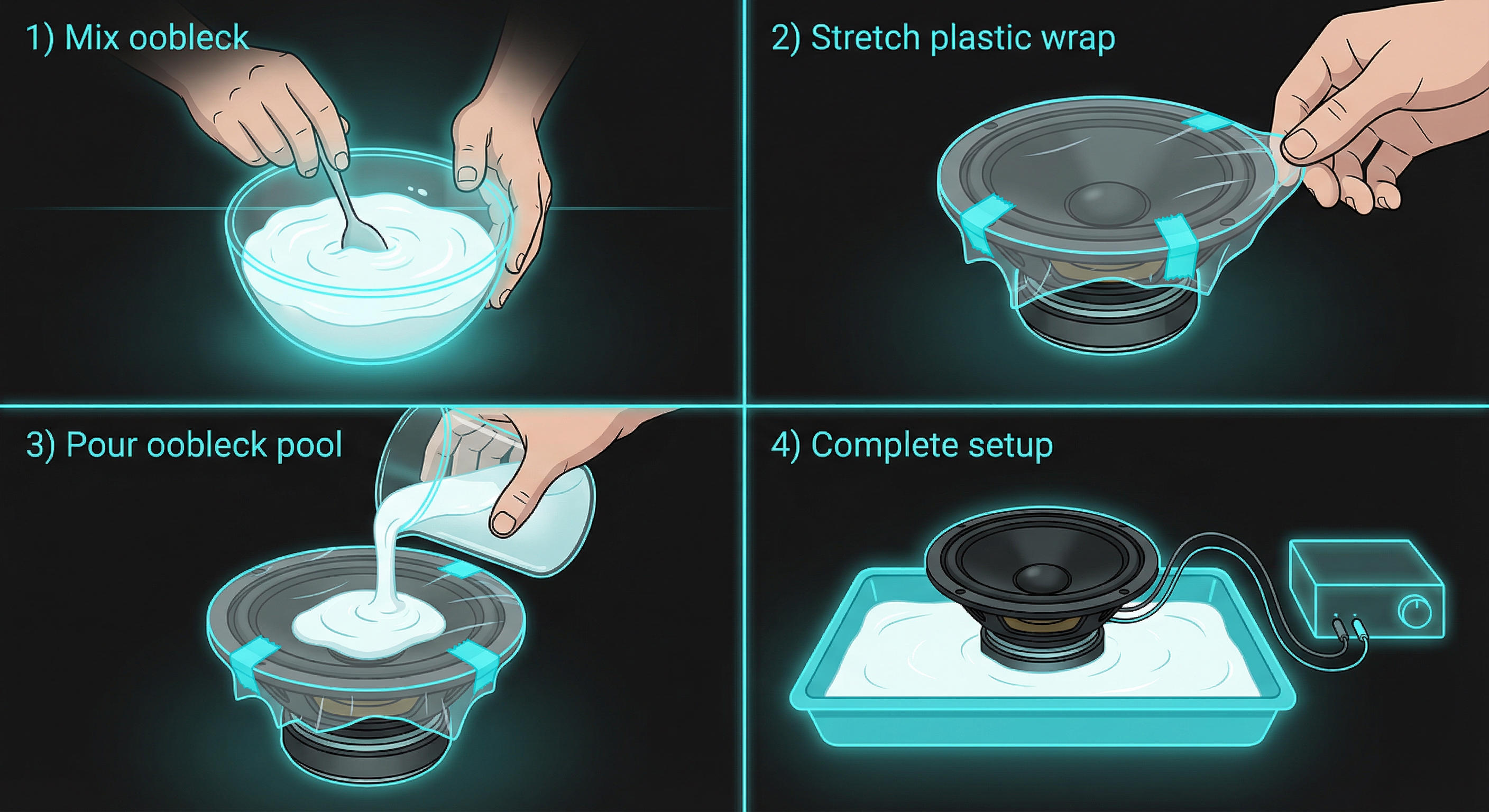 Key assembly steps: mix cornstarch + water → plastic wrap → pour oobleck → ready.
-
Mix the oobleck. Add cornstarch to the bowl and slowly pour in water while stirring. The ideal ratio is approximately 1.5–2 parts cornstarch to 1 part water by volume. The mixture is ready when it flows slowly like thick cream when tilted, but cracks and resists like a solid when you punch or stir it quickly. If it's too runny, add more cornstarch. If it's a dry clump, add water in small amounts. Optional: stir in a few drops of food coloring.
-
Prepare the speaker. Place it face-up on a stable surface. Stretch plastic wrap tightly across the cone, securing it firmly around the frame with rubber bands or tape. The wrap must be taut and wrinkle-free — slack wrap will absorb the speaker's motion rather than transmitting it to the fluid.
-
Place the speaker in a tray or on newspaper. The oobleck will crawl and splatter beyond the cone edges during operation.
-
Pour oobleck onto the center of the wrapped speaker cone. Start with a pool about 1–2 cm deep and 8–10 cm across. Too little fluid won't form visible tendrils; too much will over-dampen the speaker and may damage it.
-
Connect the signal chain: Tone generator → Amplifier → Speaker. Start with volume at zero and frequency set to 50 Hz.
-
Arrange lighting. Side-lighting or backlighting dramatically enhances the visibility of the tendrils. A single bright lamp placed low and to the side creates striking shadows. If you're filming, use a fast shutter speed or a bright continuous light.
Procedure
Phase 1 — The Awakening
Set the frequency to 50 Hz and slowly increase the volume. At low amplitudes, the surface of the oobleck will merely ripple — standard Faraday-wave behavior in a viscous fluid. Continue increasing. At a critical amplitude, the surface suddenly erupts: lumps and fingers begin to rise, hold their shape for an instant, and collapse back.
Something in the mixture wakes up. The surface buckles and reaches upward as if the fluid has just discovered it has limbs.
This onset is abrupt because shear thickening is a threshold phenomenon — below the critical shear rate, the suspension flows normally; above it, the viscosity jumps by a factor of 100 or more, and the fluid can momentarily support its own weight against gravity.
Phase 2 — Frequency Tuning
Sweep the frequency slowly between 30 Hz and 80 Hz while maintaining a strong amplitude:
- 30–40 Hz: Large, slow-moving mounds that rise and fall heavily. The long oscillation period gives the fluid time to partially re-liquify between cycles, producing blobby, organic shapes.
- 40–60 Hz: The sweet spot for most setups. Tendrils become tall, distinct, and finger-like. Individual protrusions may reach 5–10 cm above the surface. At resonant frequencies of your speaker-fluid system, the tendrils become especially vigorous.
- 60–80 Hz: Faster oscillation produces smaller, more numerous protrusions. The texture shifts from fingers to a frothy, boiling appearance. Surface detail increases but individual tendrils are shorter.
Find the frequency that produces the tallest, most distinct tendrils on your setup — this is the resonant sweet spot where the speaker's excursion, the fluid's mass, and the shear-thickening threshold align.
Phase 3 — Amplitude Dynamics
At your resonant frequency, explore the full amplitude range:
- Low amplitude: Gentle surface ripples. The fluid behaves almost Newtonian.
- Medium amplitude: Surface breaks into small mounds that rhythmically rise and fall.
- High amplitude: Full tendril formation. Fingers reach upward, sometimes bending and splitting at the tips. Droplets may be flung from the peaks.
- Maximum amplitude: Chaotic eruption. Oobleck crawls over the edge of the speaker. Tendrils collide, merge, and fragment. The entire mass appears to be boiling.
Notice the hysteresis: when you reduce amplitude from high to low, the tendrils persist at amplitudes below the level at which they first appeared. The fluid's microstructure retains some memory of the jammed state.
Phase 4 — Waveform Experiments
If your tone generator supports different waveforms, try:
- Sine wave: Smooth, regular tendril pulsation. Each cycle produces one rise-and-fall.
- Square wave: Sharper, more violent eruptions. The instantaneous transition from negative to positive excursion subjects the fluid to the highest shear rates, producing the most dramatic solidification events.
- Music (bass-heavy): Play a track with strong, clean bass. The tendrils will dance to the rhythm, rising with each kick drum and bass note. Dubstep and electronic music with sub-bass drops produce spectacular results.
Phase 5 — Cleanup
- Turn the volume to zero and disconnect the amplifier.
- Scoop the oobleck back into the bowl — it's reusable if kept sealed.
- Remove the plastic wrap carefully and inspect the speaker cone for any leaks.
- Wipe the speaker frame with a damp cloth.
- Dried cornstarch residue brushes off surfaces easily with a dry cloth. Wet residue dissolves in water — do not use solvents.
Oobleck can be stored in a sealed container for a day or two, but will eventually separate. Re-stir before reuse. For disposal, it's safe to wash down the drain in small quantities with plenty of water.
Sources
- Barnes, H.A. "Shear-Thickening ('Dilatancy') in Suspensions of Nonaggregating Solid Particles Dispersed in Newtonian Liquids." Journal of Rheology 33, no. 2 (1989): 329–366.
- Brown, Eric, and Jaeger, Heinrich M. "Shear Thickening in Concentrated Suspensions: Phenomenology, Mechanisms, and Relations to Jamming." Reports on Progress in Physics 77, no. 4 (2014): 046602.
- Fall, Abdoulaye, et al. "Shear Thickening and Migration in Granular Suspensions." Physical Review Letters 105, no. 26 (2010): 268303.
- Merkt, F.S., et al. "Persistent Holes in a Fluid." Physical Review Letters 92, no. 18 (2004): 184501.
- Jenny, Hans. Cymatics: A Study of Wave Phenomena and Vibration. Basel: Basilius Presse, 1967.